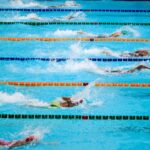
There’s a version of Olympic swimming history that lives in official record books — split times, medal counts, world records etched in chlorine-faded plaques. Then there’s the version that actually happened: the pre-race rituals in dim locker rooms, the coaches scrawling split targets on legal pads, the athletes shaking out their arms on pool decks that smelled like ambition and industrial-grade disinfectant. That version is harder to find, and it’s the one worth looking at.
The Pool Deck as a Cultural Stage
From the 1972 Munich Games through the Speedo LZR Racer controversy at Beijing 2008, competitive swimming has never been purely athletic. It’s always been political, aesthetic, and deeply human. Mark Spitz’s seven gold medals came with a mustache that NBC commentators literally questioned on air — a detail that tells you everything about how image and performance were already inseparable at the highest level. The behind-the-scenes photographs from that era show something the broadcast footage never captured: the waiting. Athletes sitting on metal benches in ill-fitting tracksuits, staring at nothing, headphones nonexistent, the psychological preparation entirely internal and entirely visible on their faces.
By the 1984 Los Angeles Games, the aesthetic had shifted. Corporate sponsorship had arrived in full force, and the pool deck looked like a branded environment for the first time. The warm-up gear was cleaner, the signage was everywhere, and photographers like Tony Duffy at Allsport were getting access that produced genuinely iconic behind-the-scenes work — not just podium shots, but the in-between moments that defined what competitive swimming looked like to a generation of young swimmers who’d paper their bedroom walls with those images.
When Suits Changed Everything
The technological rupture that reshaped competitive swimming’s visual identity happened fast. Speedo’s Fastskin, introduced at Sydney 2000, turned swimwear into a genuine engineering story. Suddenly the suits themselves were the news — full-body coverage, sharkskin texture, biomimetic design language that made swimmers look more like deep-sea vehicles than athletes. The behind-the-scenes photographs from that period capture the fitting sessions, the technical briefings, the almost surgical attention to suit application. Michael Phelps and Ian Thorpe didn’t just train differently; they prepared for competition differently, with gear technicians and fabric engineers in the frame alongside coaches.
The LZR Racer era that followed — banned by FINA in 2010 after forty-three world records fell in a single year — produced some of the most visually striking behind-the-scenes documentation in the sport’s history. Photographs from the Beijing aquatics center show athletes layering multiple suits, coaching staff with stopwatches and laptops, a sport mid-transformation and fully aware of it.
What connects all of it — from Spitz’s Munich pool deck to the hydrodynamic labs feeding data into modern suit design — is the gap between what television shows and what actually happened. The galleries in this post exist in that gap. Look at the faces, the posture, the gear. The records are in the books. The story is here.
— Jordan Vale, Editor in Chief, Swim Rags