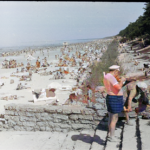
Before Instagram flattened everything into the same warm preset, before editorial beach shoots required a mood board and a Pinterest reference folder, there was a decade when California coast photography happened fast, loose, and in actual sunlight. The 1960s produced some of the most enduring beach lifestyle imagery ever made — and it wasn’t an accident.
Why the 1960s California Coast Produced Iconic Beach Photography
The convergence was almost too perfect. Kodachrome 64 film gave photographers saturated, stable color that could hold up under direct Pacific sun without blowing out. Cameras like the Leica M3 and early Nikon F bodies were small enough to carry down a cliff path to Malibu or Rincon without a grip truck in tow. And the subjects — surfers, beach bunnies, musicians cutting out of Laurel Canyon for the weekend — weren’t performing for the camera yet. They were just living, and photographers like LeRoy Grannis and Ron Stoner were there to document it.
Grannis in particular deserves more credit than he typically gets outside surf photography circles. A former telephone company lineman who picked up shooting competitively in his forties, he shot for Surf Guide and International Surfing Magazine through the mid-60s, often strapping himself to a pier or climbing above the break to get elevation nobody else thought to look for. His images of Huntington Beach contests and empty Malibu lineups defined what surf photography looked like for a generation of shooters who came after him.
The Aesthetic: What Made 1960s Beach Style Photography Look the Way It Did
The fashion was inseparable from the photography. Catalina Sportswear and Cole of California were putting women in structured one-pieces and early bikinis with clean geometric lines — graphic shapes that read clearly on film, even at distance. Men were in jams and baggies, board shorts cut long and loose, often made from Hawaiian cotton prints that Hobie Alter and the early surf labels were pulling from Pacific Rim textile suppliers. These weren’t swimsuits designed with a photo shoot in mind, which is exactly why they photographed so well — there was no artifice to see through.
The light mattered as much as the clothes. Southern California’s marine layer burns off by mid-morning and leaves a diffused, high-contrast afternoon light that photographers now chase with $400 light modifiers. In 1963, you just showed up after ten and let the coast do the work. That quality of light — the way it catches water spray, flattens shadow in the sand, and makes a bleached-out blonde look practically luminescent — is what every beach lifestyle photographer working today is still trying to replicate, consciously or not.
There’s also the cultural weight of the moment. The California beach wasn’t just a location in the 1960s — it was an argument about how American life could be organized. Against the backdrop of Cold War anxiety and suburban conformity, surf culture offered a genuinely alternative template: mobile, physical, community-based, and tied to natural rhythms. Beach photography from this era carries that tension without ever stating it. That’s what gives the images their gravity, fifty years on.
If you’re shooting beach lifestyle now and your work feels weightless, look at what Grannis was doing with a Nikon F at the Huntington pier in 1965. The camera was the least interesting thing in the frame.